 GOVERNANCE OFFICER LEVEL 4
 BUSINESS ADMINISTRATOR LEVEL 3
Blog Article
The Hidden Cost of Poor Quality in Manufacturing
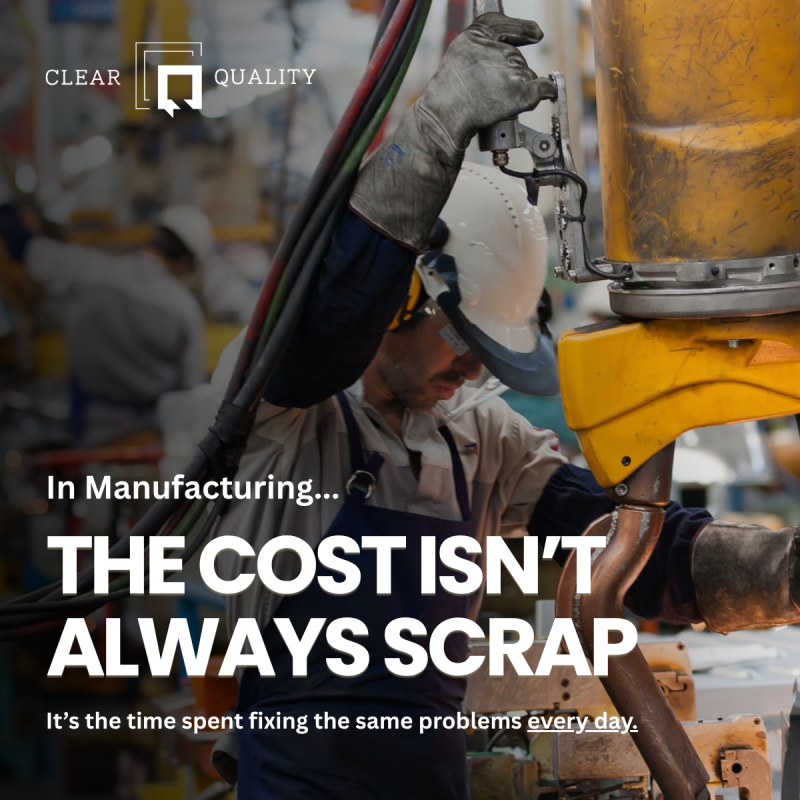
In many manufacturing businesses, quality problems don’t always appear as major failures. More often, they show up in smaller ways that gradually become part of the daily routine.
A batch of parts needs reworking. Inspection identifies an issue late in the process. Production pauses while a team works out why something has gone wrong again.
Individually, these situations may seem manageable. But when they happen regularly, they begin to add up. Time is lost correcting errors, delivery timelines start to slip, teams spend hours troubleshooting recurring issues, and production schedules become harder to maintain.
Have you ever looked closely at how much time is spent fixing problems that should not be happening in the first place?
This is often where the hidden cost of poor quality begins to appear.
What is the hidden cost of poor quality?
Poor quality rarely presents itself as one large event. Instead, it tends to show up through operational symptoms that teams simply learn to work around.
Extra inspections may be introduced to catch recurring defects. Production staff double-check stages that have caused problems before. Engineering teams find themselves investigating the same issues repeatedly.
Over time, these workarounds can become part of “how things are done”, even though they signal that something deeper in the process may not be working as effectively as it could.
From a leadership perspective, this can be difficult to see clearly. The business is still producing, orders are still leaving the factory, and problems are being resolved as they arise. But behind the scenes, valuable time, cost and resource are often being spent correcting issues rather than improving processes, creating a reactive, firefighting culture that limits efficiency.
Why do these issues keep happening?
In many organisations, processes evolve gradually as production grows, equipment changes or new products are introduced. Documentation may not always reflect the reality of how work is carried out on the shop floor, and small adjustments are often made simply to keep production moving.
Without regular review, it becomes difficult to see where recurring issues are actually coming from.
Across the manufacturing businesses we work with, we often see organisations where these small adjustments build over time, making it harder to identify the root cause of recurring problems.
Why systems alone aren’t enough
We often see organisations where quality is treated primarily as a compliance activity, focused on inspections, audits and documentation.
Across many manufacturing environments, one of the most valuable shifts happens when quality stops being viewed purely as inspection or compliance and instead becomes part of understanding how operations truly function.
When processes are reviewed regularly and improvements are made based on real operational insight, organisations often find that many of those “normal” disruptions begin to reduce. This not only improves efficiency, but also supports more consistent delivery, reduced waste and better use of resource.
How businesses are starting to address this
Increasingly, organisations are recognising that systems such as ISO provide a strong framework, but on their own they are not enough to drive meaningful change.
It is the combination of clear processes and capable people that enables businesses to identify issues earlier, respond effectively and continuously improve how they operate.
The hidden cost of poor quality is rarely just about defective parts. More often, it is the time, effort and disruption that quietly sit behind everyday production challenges. Organisations that take the time to understand these patterns are often in a stronger position to improve efficiency, strengthen quality and support more stable growth.
ISO provides the framework, but it is your team who apply it day to day, identifying issues, making improvements and keeping operations running effectively.
Organisations that focus on both are often better placed to reduce hidden costs, improve performance and create more resilient operations.